 MyDogBreeds
 Akita Inu is originated from Japan but English Setter is originated from United Kingdom. Both Akita Inu and English Setter are having almost same height. Akita Inu may weigh 41 kg / 90 pounds lesser than English Setter. Both Akita Inu and English Setter has same life span. Both Akita Inu and English Setter has almost same litter size. Both Akita Inu and English Setter requires Moderate maintenance.
 The Akita Inu, originating from Japan's snowy Akita Prefecture, has a long-standing legacy as a powerful hunting dog and loyal companion. Bred in the 1600s to track large game like boar and bear, the Akita quickly earned its place among Japanese nobility as a guardian and symbol of courage.
Its dignified nature and unwavering loyalty were immortalized in the true story of Hachikō, an Akita who waited nearly a decade for his deceased owner at a Tokyo train station. This devotion captured national and global admiration, leading to the breed’s recognition as a national treasure in Japan.
After World War II, American soldiers introduced Akitas to the West, giving rise to a larger, more robust variation known as the American Akita. Today, the Akita Inu remains a cherished breed worldwide for its strength, loyalty, and quiet dignity.
 The English Setter seems to have been a hunting dog in England as far back as the 15th century. These dogs were known to be ‘setter types’ – hunting dogs that ‘set dogges’ – to set or point at game birds. It is believed that the English Setter is a cross of the Water Spaniel, Spanish Pointer and English Springer Spaniel. In the late 1500’s Sr. Johannes Caius, a sportsman, announced to his friends that there was a new dog our of France for hunting. He then describes an English Setter.
Then in the early 1800’s Rev. Harrison of Carlise sold a couple of setters to Mr. Laverack. This pair is the foundation for the breed of English Setters. Without really knowing, Laverack claimed that this line he was breeding from had been pure for 35 previous years. He inbred his male and female for many years and did well in confirmation and field trials.
Then in 1874 the first English Setters were imported to the US from this Laverack line. Mr. Llewellin then crossed the best dogs in the Laverack line with his dogs and eventually produced winning champions Armstrong Dash II and Dashing Bondhu. This led to the “Dashing Bondhu” or the Llewellin line of English Setters. This is why the English Setter is sometimes referred to as the Llewelllin or Laverack Setter.
The setter group to which the English setter belongs includes the Irish Setter, the Gordon Setters and the Irish Red and White Setter. The English Setter, as well as the others, were bred to hunt birds such as pheasant and quail. It was the job of the setter to find the prey and point it out to the hunter after it had been shot. They were also used to flush the birds from the brush so that the hunter could then release hawks to take down the prey. The English Setter is methodical and systemic in their approach.
By the 1600’s this working dog had become the breed of the landed gentry and shooting game was their pastime. These nobles did not use hawks to capture the prey but rather shot them after the English Setter flushed them out. The English Setter is very popular today both as a hunting dog and as a family pet. The English Setter is bred for athleticism and endurance. The have both AKC and UKC certification.
 The Akita Inu is a large, powerful, and dignified dog breed known for its striking appearance, quiet nature, and unwavering loyalty.
Originating from Japan, it has a broad head, erect triangular ears, and a plush double coat that comes in red, white, brindle, or sesame, with characteristic urajiro (whitish markings). The Akita carries itself with pride and confidence, often aloof with strangers but deeply affectionate and protective toward its family.
Calm, intelligent, and strong-willed, the breed requires early socialization and firm, consistent training. Though not ideal for first-time owners, the Akita Inu is a loyal guardian and devoted companion for those who understand and respect its independent spirit.
 The English Setter is very much a setter in his looks. He is medium in size and was bred to hunt by following airborne prey over a large expanse of ground. He has to have both speed and stamina. He also has to run with his head up watching the prey in the air.
He has a slight dome shaped head and a long muzzle with dark, gentle eyes. The ears have their tips lined up with the eyes, the neck is long and muscular. He shows powerful hindquarters and a fairly long tail.
The coat length is medium and silk. The ears, chest, neck and legs are feathered, as is the tail. The hunting version has a shorter, finer coat than the show dog. The show dogs’ coats are flowing and long. Both types have a white coat with Belton or ticking. The Belton can be black, orange, lemon, liver and the tricolor. This is the liver or blue Belton but there are tan markings on the legs, chest, and face. It was Laverack who named the ticking Belton after a village in England.
 The Akita Inu is a large, noble, and powerful breed known for its dignified presence, strong loyalty, and quiet confidence. Originally bred for hunting and guarding, Akitas are naturally protective, courageous, and independent thinkers.
They form deep bonds with their family but are often aloof with strangers. Calm and clean by nature, they rarely bark without reason and carry themselves with elegance and strength.
Their double coat is thick and weather-resistant, requiring regular grooming, and they shed heavily, especially seasonally.
While intelligent, Akitas can be stubborn, so they thrive best with experienced owners who can offer consistent training and leadership. With proper care and socialization, the Akita Inu is a devoted, majestic companion.
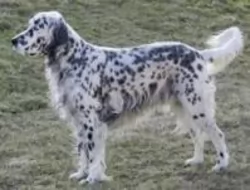 The AKC standard for the English Setter breed describes him as a “Gentleman by Nature” and that might be all you need to know about this delightful dog. They are people-oriented and settle right down with their families if they get enough exercise. With proper stimulation they become couch potatoes when you bring them in at night.
They are very friendly with everyone but are especially happy when playing with children. You can trust them with your other pets, children of all ages and anyone coming to your front door. They are not guard dogs. However, they can have a stubborn streak, they can be strong-willed. This is especially true the more working than show stock they are. In addition, they are intelligent, calm and quiet in the house.
 The Akita Inu is generally a strong and resilient breed, but it is prone to several genetic and breed-specific health issues.
Common concerns include hip and elbow dysplasia, progressive retinal atrophy (PRA), and hypothyroidism, all of which can affect mobility, vision, and metabolism.
The breed is also susceptible to autoimmune disorders like VKH-like syndrome and sebaceous adenitis, a skin condition causing hair loss and irritation. Additionally, Akitas may experience bloat (gastric torsion), a life-threatening emergency common in deep-chested dogs.
Regular veterinary care, proper diet, and responsible breeding practices are essential to help minimize health risks and ensure a long, healthy life.
 English Setters, like many other breeds that have a base white coat, can be affected by congenital deafness. A test done by LSU in 2010 showed the 12.4% of the dogs they tested were affected by this. They are also prone to:
Most of this is caused by autoimmune thyroiditis or a condition where the immune system attacks its own thyroid gland.
The primary cause of death after ten years old
 Caring for an Akita Inu involves commitment, consistency, and understanding of the breed's unique needs. They require regular grooming, especially during seasonal shedding, with brushing at least 2–3 times a week and daily during coat blow periods.
Akitas thrive on routine exercise, such as long walks or playtime in a secure area, but they aren’t overly energetic. Training and socialization should start early, using positive reinforcement and calm, firm leadership to manage their independent and protective nature.
They are best suited to homes where they are the only pet or properly introduced to others. Akitas are clean, quiet, and typically bond closely with their family, so providing mental stimulation, affection, and clear boundaries is key.
Regular vet checkups, a balanced diet, and proper social interaction help keep your Akita healthy, happy, and well-adjusted.
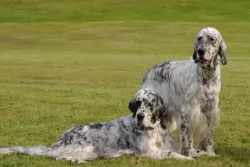 The English Setter is a hard working dog and should be fed accordingly. Puppies should be fed three times a day and adults twice to avoid bloat. Watch your English Spaniel though as they love to counter surf.
In addition to the conditions listed above the English Setter is prone to:
Caused by excessive exercise before or after having eaten a large meal. It is suggested that you feed your English Setter twice a day, smaller meals and not right before or after strenuous exercise.
Keep her ears clean and check regularly for infections.
The English Spaniel needs exercise on a routine basis – every day walks are best along with some time to just run either in a fenced yard or dog park. Take her jogging, running alongside your bike, hiking or just long walks. They do well with lure coursing, agility, confirmation, obedience and rally.