 MyDogBreeds
 Gully Terrier is originated from India but Brussels Griffon is originated from Belgium. Gully Terrier may grow 36 cm / 15 inches higher than Brussels Griffon. Gully Terrier may weigh 29 kg / 64 pounds more than Brussels Griffon. Gully Terrier may live 3 years more than Brussels Griffon. Gully Terrier may have more litter size than Brussels Griffon. Both Gully Terrier and Brussels Griffon requires Moderate maintenance.
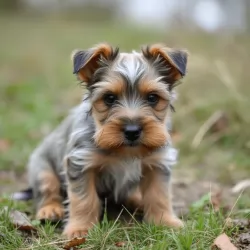 The Gully Terrier originated in India as a street dog, a mix of indigenous Indian Pariah Dogs and bully breeds like Pit Bulls and American Bulldogs.
Developed primarily for protection and hunting, they were used as guard dogs in urban and semi-urban areas. The name "Gully" refers to the narrow alleys and streets where these dogs were often found, while "Bully" highlights their muscular, strong build inherited from bully breeds.
Known for their loyalty, alertness, and protective instincts, Gully Terriers became valued companions for families in need of a strong, resilient dog that could thrive in tough environments.
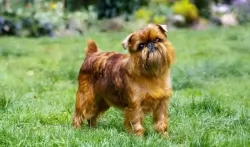 The Brussels Griffon is one of the three different types of Griffons. There is the Belgian, the Petit, and the Brussels Griffon. “Griffon” means wiry and the Brussels Griffon lives up to that moniker. The Brussels Griffon’s coat is longer than that of the Belgian Griffon and the Petit Brabanon (Griffon) has a smooth, short coat. The breed is probably originally developed by crossing Belgian street dogs with the Affenpinsher as early in the 1800’s. They were favored by the cabbies in Brussels as guard dogs. They were also bred to hunt rats. Sometime toward the end of the 19th century, the Griffon was again crossed this time with a pug. This accounts for the type of head that the Brussels Griffon has, namely a brachycephalic head. It also accounts for the smooth coat of the Petit Griffon. The modern-day Griffon may also have been crossed at some time with one or more of these breeds: the English Toy Spaniel, the Irish Terrier and the Yorkshire Terrier.
By 1880, the breed was recognized and appeared in the Brussels Exhibition of 1880. They were also found in paintings of the same era by the Flemish painter, Van Eyck. In the beginning of the 20th century, the breed was extremely popular with the nobility in Belgium. As with so many other breeds, the number of Brussels Griffon was greatly reduced during the First World War. It did not take them long however to make a comeback after the war. Their popularity then spread around the globe.
The European FCI considers the Brussels Griffon, the Belgian Griffon and the Petit Brabancon (Griffon) to be three separate breeds with no interbreeding among them. They are shown as three separate breeds in Europe, with the difference between the Belgian and Brussels being the accepted colors. The Brussels is only red in color while the Belgium Griffon can be in all other colors. In the United States the three types of Griffons are considered one breed with three varieties. Only the Brussels Griffon is recognized by the AKC. The difference in coat and color make for the different varieties in the U.S.
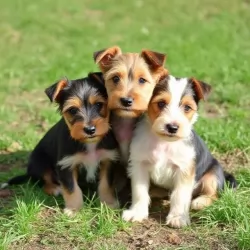 The Gully Terrier is a medium-sized, muscular dog known for its agility, loyalty, and protective nature. With a short, dense coat that comes in various colors, including black, brown, tan, and white, this breed has a distinctive appearance, often with a strong, powerful build.
The Gully Terrier is highly energetic and requires regular exercise to stay happy and healthy. Its intelligent, alert, and sometimes independent nature makes it a great guard dog and companion, although consistent training is necessary to manage its strong-willed personality.
This breed is well-suited for active families or individuals looking for a devoted and protective dog with a loving but protective demeanor.
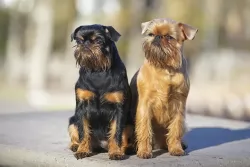
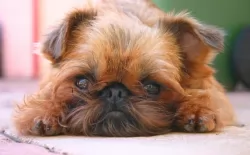 All three types of Griffons are toy size dogs with short, thick bodies and distinctive brachycephalic heads. Regardless of coat color their muzzles and whiskers are black, and they have large eyes, also black, a mustache and beard. They have black eyelashes and a nose that is very black. All this is set against their red, beige, black or black and tan coat. Their forehead is dome shaped and the muzzle is short. The breed has small ears that are high up on the dog’s head. The ears might be cropped in the United States but would not be in Europe. The lower jaw is prominent and the jaw itself is undershot. They have black toenails and pads, with strong and muscular hind legs. The Griffon has a docked, high set tail in the U.S. and a full tail in Europe and all of the United Kingdom.
The rough coated types have a dense and wiry coat and the standard encourages the hardest possible wire coat. Their heads are also wiry and long around the chin, cheeks, nose and eyes. They should be hand-stripped and never left ungroomed. The coat can matt if not taken care of adequately. One of the most important features of the Brussels Griffon is its human like face or monkey like appearance.
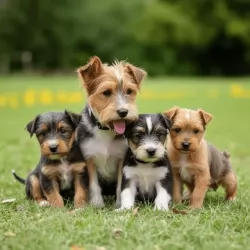 The Gully Terrier is a loyal, energetic, and intelligent breed with a strong, muscular build. Known for their protective nature, they make excellent guard dogs, staying alert and watchful of their surroundings.
While they are friendly and devoted to their family, they can also be independent and sometimes stubborn, requiring consistent training. Their short, dense coat is easy to groom, needing only regular brushing and ear cleaning.
Gully Terriers are active dogs that thrive on daily exercise and mental stimulation, making them great companions for those with an active lifestyle.
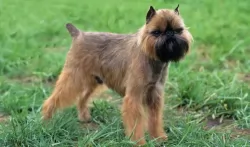 The Brussels Griffon is sociable, alert and very intelligent. She is very energetic, playful and loving. They bond deeply with their family. Housebreaking might be a challenge as it is with all toy/small breeds. They are incredibly lonely and restless when their people are not around them. They have great personalities, terrier like characteristics, and deep loyalty to their humans. They are great companions and love children. Just remember how small they are. They are susceptible to Little Dog Syndrome if the human does not establish themselves as the alpha right away.
 Like many medium to large-sized dogs, Gully Terriers can be prone to hip dysplasia, a condition where the hip joint doesn't develop properly, leading to arthritis and discomfort.
Due to their floppy or semi-erect ears, Gully Terriers can be more susceptible to ear infections. Regular ear cleaning and checking can help prevent this.
Their short coat can sometimes be prone to skin irritations, especially if they are exposed to harsh weather or poor hygiene. Allergies or parasite infestations (like fleas) can cause skin problems.
Gully Terriers are highly energetic, but they can be prone to obesity if they don't get enough exercise or are overfed. A balanced diet and regular activity are essential.
Some dogs in this breed may experience congenital eye issues like cataracts or progressive retinal atrophy (PRA), which can affect vision.
Regular vet check-ups to monitor joints, ears, and skin Consistent exercise to maintain a healthy weight Proper grooming to reduce risk of skin issues and ear infections
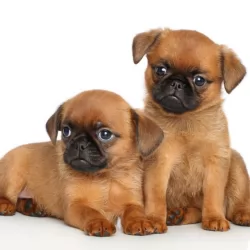 The Brussels Griffon is susceptible to many of the diseases and genetic conditions that many other toy or small dogs have. Flat-faced breeds like the Griffon also suffer from difficulty with breathing under certain weather conditions and they are known to snore. They should not be kept in hot, sunny, humid climates for this reason. They may also display patella luxation (slipping kneecaps) and hip dysplasia. Lastly, they are susceptible to ear infections. Dams are often in need of cesarean sections to deliver their litters. They have very serious health issues due to the head shape and flat face. These might include eye and respiratory issues and syringomyelia – a deadly neurological disease. They are susceptible to epilepsy, dental issues and eye lash issues.
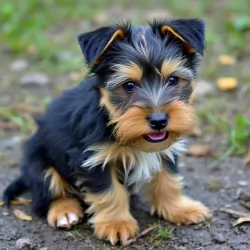 Caring for a Gully Terrier is straightforward but requires attention to their exercise, grooming, and training needs:
Gully Terriers are energetic and need daily exercise. Regular walks, runs, or play sessions will keep them happy and healthy.
They are smart and need activities that challenge their minds, like puzzle toys or training sessions.
Their short coat requires minimal care. Brush them once or twice a week and clean their ears regularly to prevent infections. Trim nails as needed.
Gully Terriers can be a bit independent, so start training early with positive reinforcement. Socialize them with people and other animals to avoid territorial behavior.
Feed them a balanced diet and control their portions to avoid weight gain. Regular vet check-ups will help keep them healthy.
 The Brussels Griffon can choke easily so take care with the size of kibble you feed them. They need about one fourth to one half of a cup of high quality dry food that is designed for small or toy dogs. Divide this amount into two or three small meals per day. Puppies should be fed more often than adults but never feed just one large meal per day. Be careful that your Brussels Griffon does not become obese.
The Brussels Griffon, regardless of type has some very serious health issues due to the shape of their heads.
Brachycephalic Syndrome – This can cause all the respiratory issues as well as eye issues such as cataracts and corneal ulcers.
This is a very playful and energetic breed that needs at least some exercise every day. They love to play with their family. They are smart and easy to train. They love agility, obedience, barn hunt and tracking activities. You can just as effectively play with and exercise your Brussels inside as well as out.