 MyDogBreeds
 Gully Terrier is originated from India but French Spaniel is originated from France. Gully Terrier may grow 7 cm / 2 inches shorter than French Spaniel. Gully Terrier may weigh 13 kg / 29 pounds more than French Spaniel. Gully Terrier may live 3 years more than French Spaniel. Both Gully Terrier and French Spaniel has almost same litter size. Both Gully Terrier and French Spaniel requires Moderate maintenance.
 The Gully Terrier originated in India as a street dog, a mix of indigenous Indian Pariah Dogs and bully breeds like Pit Bulls and American Bulldogs.
Developed primarily for protection and hunting, they were used as guard dogs in urban and semi-urban areas. The name "Gully" refers to the narrow alleys and streets where these dogs were often found, while "Bully" highlights their muscular, strong build inherited from bully breeds.
Known for their loyalty, alertness, and protective instincts, Gully Terriers became valued companions for families in need of a strong, resilient dog that could thrive in tough environments.
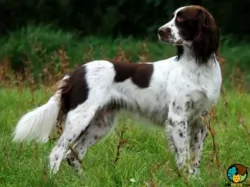 Developed in France and then in Canada, the French Spaniel is a descendent of 14th century hunting dogs. Originally the breed was very popular with the French royalty and nobility at the Court of Versailles, in the Middle Ages. A French Spaniel named Babe was owned by Catherine I of Russia.
Spaniels were mentioned in Gaston III of Foix-Beams’ The Master of the Game, or Livre de Chasse, in 14th Century France. Most believed that Spaniels had been developed during the 11th century Crusades. By 1650 the French Spaniel was differentiated from the King Charles Spaniel and determined to be its own type of spaniel.
In 1805, they were featured in the Sporting Magazine, hunting mallards. The French Spaniel was crossed with English Setters in the !850’s to develop the French Brittany (Spaniel). But by the end of the 19th century, hunting dogs from other countries were outpacing the French Spaniel so much that it was driven to the brink of extinction. Fortunately, a priest named Father Fournier saved the breed by taking all remaining Spaniels to his kennels at St. Hillarie and developing the lines we see in the breed today. This was followed by the founding of the French Spaniel Club in 1921. The various lines of the Spaniels included the French Spaniel of today, the Brittany of today, the Blue Picardy and the Picardy.
The French Spaniel however has been rare outside of its native country and Canada, where it was imported in the 1970’s to French speaking Quebec. Quebec Canadians fell in love with the breed for hunting grouse and woodcock. In order to ensure that the breed would be continued in line with its French standards, the Club de l’Epagneul Francais du Canada began in 1978. By 1985 the Canadian Kennel Club recognized the French Spaniel. Soon after they were recognized by the United Kennel Club, the Federation Cynoloqique Internationale, the UK Kennel Club and the North American Versatile Hunting Dog Association, but not the AKC (American Kennel Club). They are also registered with organizations such as the American Canine Association, the Dog Registry of America and the America’s Pet Registry. They have been included in the AKC Foundation Stock Service as the first step toward AKC recognition.
 The Gully Terrier is a medium-sized, muscular dog known for its agility, loyalty, and protective nature. With a short, dense coat that comes in various colors, including black, brown, tan, and white, this breed has a distinctive appearance, often with a strong, powerful build.
The Gully Terrier is highly energetic and requires regular exercise to stay happy and healthy. Its intelligent, alert, and sometimes independent nature makes it a great guard dog and companion, although consistent training is necessary to manage its strong-willed personality.
This breed is well-suited for active families or individuals looking for a devoted and protective dog with a loving but protective demeanor.
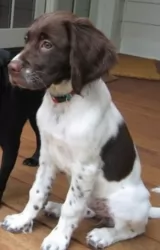 The French Spaniel is a very tall dog and as such is one of the spaniel breeds two tallest. They are taller than the English Springer Spaniel, have a deep chest and a muscular build. Their legs are very strong, and they have a thick tail that is never docked. It is long, slightly curved and hangs low. He is an elegant dog with dark amber eyes, long feathery ears, and a nose the color of the coat. If the coat is brown the nose is brown. If the coat is black and white the nose is black. Most French Spaniels are white with brown or dark liver or white with black.
 The Gully Terrier is a loyal, energetic, and intelligent breed with a strong, muscular build. Known for their protective nature, they make excellent guard dogs, staying alert and watchful of their surroundings.
While they are friendly and devoted to their family, they can also be independent and sometimes stubborn, requiring consistent training. Their short, dense coat is easy to groom, needing only regular brushing and ear cleaning.
Gully Terriers are active dogs that thrive on daily exercise and mental stimulation, making them great companions for those with an active lifestyle.
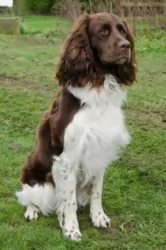 Yes, they are very good with children.
They are great in filed trials as they can flush, point and retrieve.
The breed is very adaptable and can live in the city or in the country.
The breed is very intelligent and trainable.
 Like many medium to large-sized dogs, Gully Terriers can be prone to hip dysplasia, a condition where the hip joint doesn't develop properly, leading to arthritis and discomfort.
Due to their floppy or semi-erect ears, Gully Terriers can be more susceptible to ear infections. Regular ear cleaning and checking can help prevent this.
Their short coat can sometimes be prone to skin irritations, especially if they are exposed to harsh weather or poor hygiene. Allergies or parasite infestations (like fleas) can cause skin problems.
Gully Terriers are highly energetic, but they can be prone to obesity if they don't get enough exercise or are overfed. A balanced diet and regular activity are essential.
Some dogs in this breed may experience congenital eye issues like cataracts or progressive retinal atrophy (PRA), which can affect vision.
Regular vet check-ups to monitor joints, ears, and skin Consistent exercise to maintain a healthy weight Proper grooming to reduce risk of skin issues and ear infections
 The French Spaniel is a healthy breed that adapts well to all types of conditions, especially wet ones. There are some potentially serious health issues that the breed may be susceptible to:
This is a very serious inherited disorder. It is one of many Hereditary Sensory Autonomic Neuropathies (HSN) disorders. This is an agonizing infliction that causes the dogs to have no pain in certain extremities and therefore the ability to self-mutilate their feet, pads, claws and digits. They lick and bite their feet often amputating footpads, claws, and digits without feeling any pain. This leads to infection and most dogs end up being euthanized. The disorder shows up by 3-4 months of age.
Make sure the dog’s ears are cleaned regularly to remove wax and prevent infections.
This disease causes seizures but can be treated with medication.
Can cause lameness and arthritis.
 Caring for a Gully Terrier is straightforward but requires attention to their exercise, grooming, and training needs:
Gully Terriers are energetic and need daily exercise. Regular walks, runs, or play sessions will keep them happy and healthy.
They are smart and need activities that challenge their minds, like puzzle toys or training sessions.
Their short coat requires minimal care. Brush them once or twice a week and clean their ears regularly to prevent infections. Trim nails as needed.
Gully Terriers can be a bit independent, so start training early with positive reinforcement. Socialize them with people and other animals to avoid territorial behavior.
Feed them a balanced diet and control their portions to avoid weight gain. Regular vet check-ups will help keep them healthy.
 A high quality dry food made for puppies and if possible for Spaniels. Feed two to three times a day about one fourth of a cup each time
A high quality adult dry food made for Spaniels if possible. Feed twice a day about one half to three fourths of a cup at each meal.
Excellent vision, stamina and speed.
These dog love to run and play. They are smart and learn easily. They like to chase balls, swim, play hide and seek, Find It, and go hiking. They can excel at learning tricks, agility, rally and obedience trials.